
The newly approved statute institutionalizes the CCP’s harsh attitude toward minorities and their languages and cultures.
“Learn Chinese and become a civilized person.” This slogan, employed during China’s 2020 sinicization campaign in Obor Mongol—Southern or Inner Mongolia—signaled the central government’s determination to reinforce the primacy of Mandarin Chinese, as part of an overall effort to boost “national unity.”
From television screens to public notices to classrooms, the message directed at the people of Southern Mongolia was clear: assimilate, and quickly. Government propagandists issued calls to improve “the mutual interaction, mutual exchange, and mutual assimilation of all ethnic groups to firmly establish the Chinese national common identity.”
Local level cadres undertook “Special Training for Inculcating the Sense of Chinese Nationality Common Identity.” Public signage provided a “Gentle Reminder—Speak Mandarin in Public.” Schoolchildren were discouraged from referring to “Mongolian culture,” in favor of something called “Chinese grassland culture.” Televised presentations of Tsagaan Sar, the Mongolian lunar new year, started featuring Peking opera performances and Chinese suona horns, rather than traditional tsam dances and morin khuur fiddling.
It was in these ways, with their varying levels of subtlety, that the government hoped to instill a “strong sense of Chinese national common identity,” though for Enghebatu Togochog, director of the Southern Mongolian Human Rights Information Center, the goal of this campaign of ideological education was really “to completely eradicate Mongolian language, culture and identity.”
Such is the so-called civilizing mission of the CCP, perhaps best summed up by another sinister slogan: “Break lineage, break roots, break connections, and break origins.” Those lineages, roots, connections, origins, languages, and customs are allegedly what are preventing ethnic minority groups in China from becoming “civilized.”
Communities that speak Mongolic languages, or write in the Hudum Mongol Bichig vertical script, have supposedly failed to attain a proper state of civilization, just as the speakers of Uyghur, Tibetan, Kazakh, Zhuang, Yi, and other non-Putonghua (Standard Chinese) languages have likewise fallen short of Chinese civilizational standards.
One cannot help but be reminded of the imperial Chinese conception of civilization and barbarism, predicated on the notion that the central state (Zhongguo), suffused with superior virtue (de) and benevolence (ren), would employ royal power (wanghua) and higher education (jiaohua) to bring barbarians into the civilized fold (guihua). The barbarians themselves were divided into the categories of “raw” (sheng) and “cooked” (shu)—a binary opposition that has endlessly fascinated anthropologists—with the emperor’s civilizing agents serving as cultural chefs, as it were.
This curious sort of culinary symbolism is unintentionally revealing, implying as it does that “raw” cultures are simply waiting to be harvested, processed, butchered, cooked, digested, and absorbed, presumably via sinicization, lest they spoil and perish.
That one must learn Mandarin Chinese to attain a true state of civilization is part of what the Australian Sinologist James Leibold has called “a Han male, Beijing-centric definition of what it means to be Chinese.” And while it might seem strange that a regime ostensibly based on scientific socialism and international proletarian revolution would adopt such a nationalistic and ethnocentric view, we should remember that even Lenin warned that “scratch some communists, and you will find Great Russian chauvinists,” a state of affairs with continuing relevance in modern-day China. What is more, the attitude Leibold described is now being enshrined in law.
On March 12, 2026, China’s National People’s Congress (NPC) adopted the Law of the People’s Republic of China on Promoting Ethnic Unity and Progress (中华人民共和国民族团结进步促进法), codifying General Secretary Xi Jinping’s doctrine of “Important Thinking on Improving and Strengthening Ethnic Work.” The law begins with a lengthy preamble describing China as “a community of common destiny bound by intertwined bloodlines, common beliefs, cultural similarities, economic interdependence, and close emotional ties,” before proceeding to its various goals of “Building a Shared Spiritual Home,” “Facilitating Interactions, Interchanges, and Intermingling,” and “Promoting Common Prosperity and Development.”
The goal of the legislation, we are told, is to foster identification with “the great motherland, the Chinese nation, Chinese culture, the Communist Party of China, and socialism with Chinese characteristics” through patriotic education and the promotion of “the fine Zhonghua traditional culture,” centered on “Chinese cultural symbols and image of the Chinese nation.”
Chapter IV, “Promoting Common Prosperity and Development,” stresses the need for “civic and moral development,” which can only be attained by “transforming outdated customs and traditions” and “promoting a new culture of civility and progress.” Thus do we encounter, yet again, the spurious distinction between the raw and the cooked, the uncivilized and the civilized, the outdated and the modern, the regressive and the progressive.
Ethnic minority groups, who have been accused of harboring “narrow national sentiments,” are to be sinicized and made to join the “Chinese Cultural Garden” (the title of an Inner Mongolia TV news program). Minority languages and texts are treated as museum pieces, with Chapter II, Article 15, Paragraph 5 of the law making allowances for the standardization, digitization, and preservation of minority languages, but only to “protect languages from being completely forgotten rather than protecting their ongoing, everyday use by living people.”
The researchers Jesse Segura and Filka Sekulova, in their investigation into “Inner Mongolian poetry and song as a form of resistance,” warned of the “erasure and museumification of the Mongolian culture,” and here we see the government’s cultural endgame hardly being disguised.
China’s new Law on Promoting Ethnic Unity and Progress is fundamentally precatory, heavy on generalized policy statements, and surprisingly light on substance. However, Chapters V and VI do address enforcement mechanisms. Chinese citizens are urged to report activity that “undermines ethnic unity and progress,” and state procuratorates are empowered to pursue public-interest litigation when conduct in the cultural sphere is found to undermine national interests. Still, for the most part, the actual imposition of the law will be handled by pre-existing provisions in the criminal code.
Interestingly, Article 63 of the law provides for jurisdiction over foreign organizations or individuals deemed to have committed “acts targeting the PRC that undermine ethnic unity and progress or create ethnic division,” something which may affect the work of international human rights activists in the future.
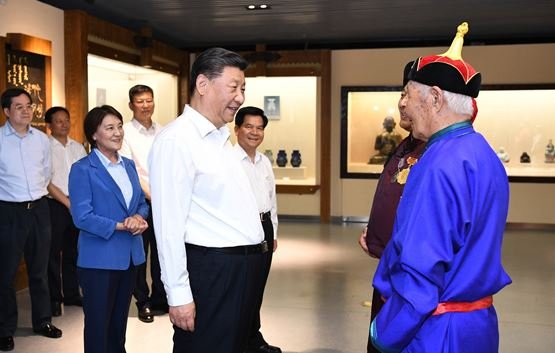
What makes this new piece of legislation significant is not its statutory language and enforcement mechanisms, but its ideological components. It has enshrined Xi’s ethnic policy, with its conception of a Han-centric Zhonghua culture serving as China’s trunk, and the 55 other ethnic minority groups as “branches and leaves” in dire need of pruning. We all know by now what “civic and moral development” means when it comes to Southern Mongolia, Tibet, East Turkestan, and elsewhere.
In recent days, in these very pages of “Bitter Winter,” we have seen reports of a Kazakh scholar, Adil Semeykhanuly, sentenced to six and a half years in a Xinjiang prison, on the absurdly vague charges of having “negatively propagated the teachings of [the Kazakh poet Abai Kunanbaev]” and “formed a separate public opinion.”
The Law on Promoting Ethnic Unity and Progress mobilizes every aspect of Chinese society, from individuals and families to businesses and mass organizations, from neighborhood committees and religious institutions to the military and the press and the military, to promote integration and prevent the spread of “information containing ethnic hatred, ethnic discrimination, or other content that undermines ethnic unity and progress.”

